
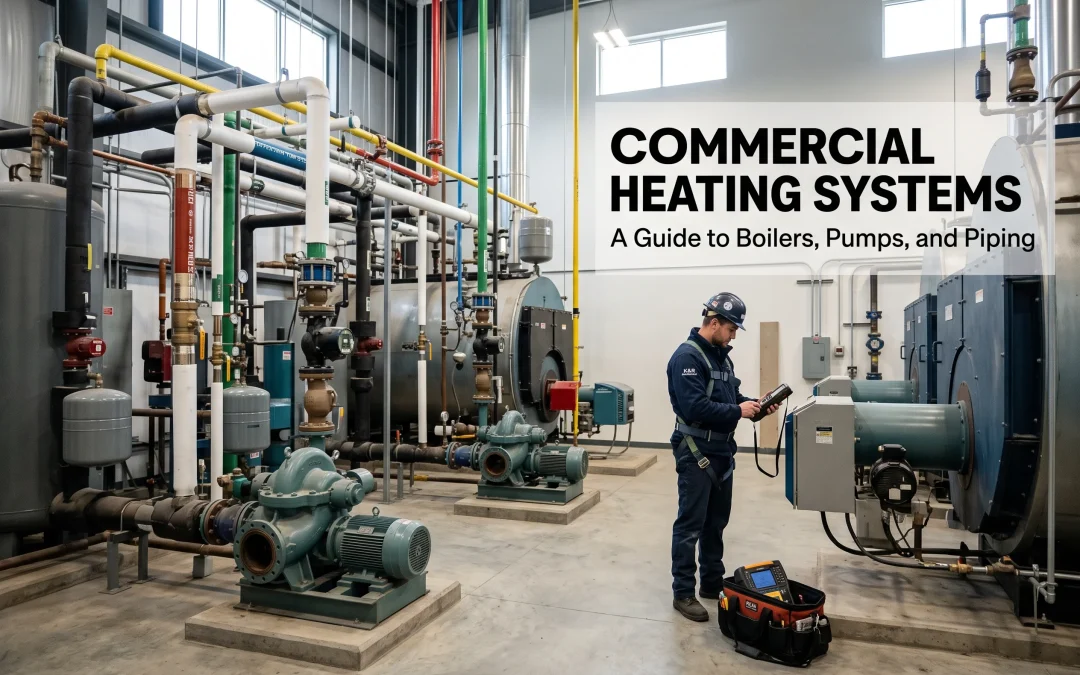
Most mid-size and large commercial buildings heat with water. Not air. Water.
Engineers call it a hydronic loop, and it’s the backbone of most commercial heating systems. Think of the boiler as the stove and the pumps as the muscle. The piping? That’s the highway out to every coil, radiator, and water heater in the place. Nobody notices any of it while it’s working. Nobody.
When one piece slips, though, you’ll hear about it. Maybe it’s a gas bill that keeps creeping up for no clear reason. Or a boiler that locks out on the coldest morning of the year. At K&R Mechanical we install, repair, and maintain commercial boilers in Houston, which means a good chunk of our week happens in mechanical rooms. So here’s the plain-English rundown, piece by piece.
Planning a boiler upgrade? Chasing a loop that won’t heat evenly? Give us a ring at (281) 408-9414. We’ll get somebody out there.
How a Commercial Heating System Moves Heat
It’s a closed loop. Hot water leaves the boiler, the pumps shove it down the supply line, and wherever it lands (a coil, a radiator, whatever) it dumps its heat into the room. Cooler now, it rides the return line home. Gets reheated. Goes again. All day long.
What sits at the end of the pipe depends on the building. In office towers it’s usually hot water reheat coils inside VAV boxes. Older schools and churches might still be running baseboard radiators or cabinet unit heaters. Hospitals, hotels, and labs? They’ll often hang a heat exchanger off the boiler plant too, and make their domestic hot water from the same source.
Then there’s the supporting cast. Easy to overlook, but the loop gets cranky without them.
Expansion tanks. Heat water and it grows. In a sealed system that extra volume needs somewhere to go, and the tank is it.
Air separators. Air in a hydronic loop is bad news: gurgling pipes, corrosion, pumps that wear out early. The separator pulls it out.
Control valves. Each zone asks for heat. The valve decides how much it actually gets.
Building automation. The brains of the operation. It checks outdoor temperature and live load, then decides how many boilers fire and how hard the pumps work.
Picking the Right Commercial Boiler
Everything downstream depends on the boiler. Get the selection wrong and the building pays for it on every gas bill for years. Sometimes decades. When we’re sizing or replacing one, we usually narrow it down with four questions.
Hot Water or Steam?
Hot water, in most modern buildings. It runs at lower pressure, responds well to modulating controls, and pairs naturally with VAV reheat coils.
Steam’s still around, though. Hospitals use it. So do older high-rises, commercial laundries, and food plants, pretty much any place where sterilization or process steam is baked into the daily routine. The tradeoff is more to babysit. Feed pumps, condensate return, and water chemistry that needs a close eye.
Condensing or Non-Condensing?
A condensing boiler squeezes extra heat out of flue gas that a standard boiler would just send up the stack. The trick? Return water has to come back cool enough for that flue gas to actually condense. For natural gas equipment, that’s generally somewhere under 130°F. Feed one hot return water and you’ve paid for a condensing boiler that barely condenses. Low-temperature reheat loops and outdoor reset controls are where these units earn their keep.
Non-condensing boilers are less picky. Hot return water doesn’t bother them, and they’re usually cheaper on day one. Steam plants, high-temperature process loads, older retrofits built around hot water: that’s where they still make plenty of sense.
Fire-Tube or Water-Tube?
Fire-tube boilers send the hot combustion gas through the tubes, with water all around the outside. They hold a lot of water and like steady loads. That’s why so many small and mid-size commercial buildings have one.
Water-tube boilers flip it. Water’s inside the tubes and the gas is outside. They heat up faster and take higher pressure, so large campuses and industrial sites with heavy or swinging demand tend to go this route.
What Fuel?
Around Houston, it’s almost always natural gas. Electric boilers make sense when a building doesn’t have gas service, when the load is small, or when the project has emissions targets to hit. Oil-fired? Rare in this region now.
Pumps Are What Actually Move the Heat
A boiler can make all the heat it wants. If the pumps are undersized or worn out, that heat never reaches the far end of the building. K&R Mechanical services the full range of commercial HVAC pumps you’ll find in Houston heating and cooling plants.
The Pumps You’ll Run Into
Inline circulators sit right in the pipe run. Smaller loops, single zones.
End-suction base-mounted pumps. Bolted to a concrete pad, built for the bigger volumes a central plant pushes around.
Split-case pumps. These handle the highest flows on big campuses and high-rises, and the casing opens for service without disconnecting the piping. Handy on service day.
Boiler feed pumps keep steam boilers supplied with water and hold the level where it’s safe.
Primary-Secondary Pumping and VFDs
A lot of commercial plants split the pumping job in two. One pump (the primary) only cares about the boiler. Its whole job is pushing water through at whatever flow rate the manufacturer spells out. The secondary side worries about the building and sends out just what the zones want, no more. You end up with a protected boiler and a distribution side that can ramp up and down on its own.
Then there’s the VFD, short for variable frequency drive. It lets a pump slow down when demand drops. Here’s the nice part: pump energy falls off sharply as speed comes down. Hook VFDs into the building automation and you’ve got one of the quickest efficiency wins in a heating plant upgrade.
When a Pump Is Telling You Something
- Grinding, rattling, or screeching from the motor or bearings
- Water at the shaft seal
- Vibration in the piping you can feel with your hand
- Zones going cold while the boiler runs fine
- Cavitation. It sounds like gravel going through the pump, and once you’ve heard it, you won’t forget it.
Real example. On a data center job called The Bunker, our crew piped in two owner-provided chillers and swapped the seals and bearings on the existing pumps. Different system, same lesson for heating loops. Catch a worn seal early and you skip the water damage and the surprise shutdown.
Why the Last Room on the Loop Stays Cold
Ever had a loop where the last few rooms never seem to warm up? Usually, that’s a piping story. Layout decides whether every zone sees the same supply temperature, or whether some get leftovers.
Direct return is the cheap, short route back to the boiler. Downside? Zones closest to the boiler hog the flow, and you need balancing valves to share it out fairly.
Reverse return flips the order. First zone supplied, last zone returned. Every circuit winds up with about the same pipe length, so flow mostly evens itself out.
Primary-secondary piping uses a pair of closely spaced tees to hydraulically split the boiler loop from the building loop. Got condensing boilers or a multi-boiler plant? This is pretty much the standard.
On materials: black steel for the big mains, copper on a lot of the smaller branches. Pressed or grooved fittings are a lifesaver in occupied buildings because they go in fast. And please insulate the supply and return lines. Otherwise you’re heating the ceiling space instead of the rooms.
Corroded old pipe that keeps springing leaks? Our K&R Mechanical commercial plumbing team can repipe it while the boiler or water heater work is underway.
Yes, Houston Buildings Need Commercial Heating
Heat? In Houston? Fair question in a city that’s hot and sticky most of the year. Still, plenty of buildings here keep a boiler running twelve months straight.
Reheat is a big reason. VAV systems in offices and medical buildings often cool air hard to wring the moisture out, then warm it back up before it reaches the room. So the boilers stay busy in August. Yes, August.
Hot water’s another. Hospitals, hotels, restaurants, and labs go through a lot of it, and many make it off the central boiler plant.
And then there’s the freeze. Remember February 2021? Unprotected pipes and idle heating equipment failed fast in a city that almost never sees a long hard freeze. Test the boilers, pumps, and freeze protection controls before winter shows up and you’ve got a much better shot next time.
What Preventive Maintenance Should Cover
Preventive maintenance is boring. It’s also what keeps commercial heating systems efficient and the 2 a.m. phone calls rare. On a typical visit, we’re handling:
- Combustion analysis and burner adjustment on every boiler
- Inspection of heat exchangers, flue passages, and venting
- Safety controls, low-water cutoffs, and relief valves. Test them every time. No exceptions.
- Pump lubrication, alignment checks, and a look at the seals
- Water treatment testing for scale and corrosion
- Strainer cleaning and air separator checks
- Making sure the control sequences and outdoor reset settings still match how the building actually runs
Texas adds its own wrinkle. If your boiler falls under the state boiler program, it needs a certificate of operation from the Texas Department of Licensing and Regulation, plus periodic inspections. Keep the maintenance records current and those inspections go a lot smoother.
Repair or Replace? Signs It’s Time to Call
Call for an evaluation if any of this sounds familiar:
- Gas bills going up even though occupancy and weather haven’t changed
- Boilers short cycling or locking out
- One floor too warm, another too cold
- Corrosion, scale, or leaks at the boiler or the piping joints
- The same pump needing seals or bearings again and again
- Equipment past its expected life, with parts getting harder to track down
Our general rule of thumb (every building’s a little different): if the boiler shell and heat exchanger are sound and one part is acting up, repair it. Major parts failing, efficiency well behind newer equipment, or a heating load that’s changed since install? Then replacement deserves a real look.
Frequently Asked Questions
What are the best heating systems for commercial buildings?
Depends on the building. Hot water boilers with variable speed pumps are the safe bet for most offices, schools, and medical buildings. Steam is for facilities with process or sterilization needs. A smaller building can sometimes get away with gas-heat rooftop units or heat pumps. Size, load profile, existing piping, and fuel availability all play into it.
How long do commercial boilers typically last?
Longer than most people expect, if they’re looked after. A well-maintained cast iron or steel boiler can run for several decades. Some high-efficiency condensing units have shorter expected lives. The single biggest factor? Water treatment and a service visit every year.
How does a boiler circulating pump work?
It’s not lifting water like a well pump. An impeller spins, pushes hot water out the supply side, and it comes back around. All the pump really fights is friction (pipes, valves, coils) to keep things moving.
Is hydronic heating efficient?
For most commercial buildings, yes. Water carries way more heat than the same volume of air, so pipes beat big ducts and fans on energy. Throw in condensing boilers, variable speed pumps, and outdoor reset, and it gets better still.
Should a hydronic heating system be flushed?
If water tests show sludge, scale, or heavy corrosion, yes. Same before tying a new boiler into old piping, since a lot of manufacturers want clean system water to keep the warranty valid. After that, stay on top of water treatment so you don’t have to do it again.
Schedule Commercial Heating Service With K&R Mechanical
Boilers, pumps, and piping are one system, and trouble in any of them shows up the same way. Higher bills. Cold zones. Downtime. Our team brings more than 35 years of field experience to commercial heating installation, repair, and maintenance across Houston. Want proof? Our chiller, pump, and piping work for clients like Foxconn and HEB Distribution is up in the K&R Mechanical project gallery.
Call (281) 408-9414 to get on the schedule or set up a consultation. Something down right now? Same number, 24/7.