
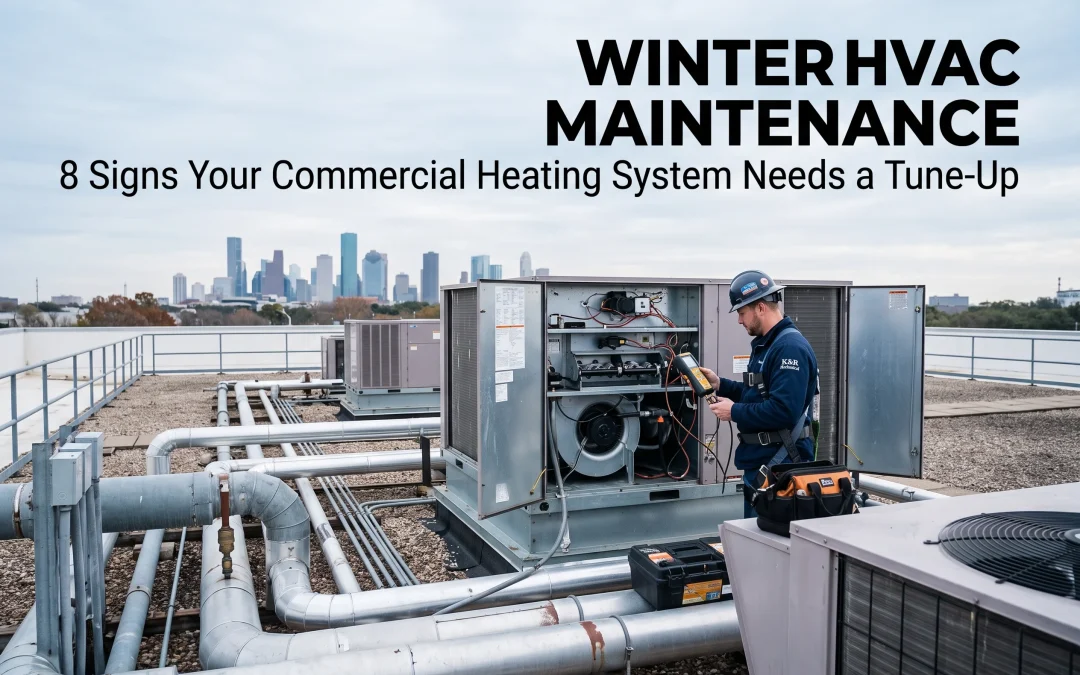
Houston winters are short. They’re not harmless.
Boilers, gas-fired rooftop units, and unit heaters spend most of the year sitting idle or barely working. Meanwhile, little problems grow. Quietly. Then the first real cold front rolls through and everything gets switched on at once, which is exactly when you find out what broke over the summer. Winter HVAC maintenance is the cheap way to find out sooner.
At K&R Mechanical we tune up and repair commercial boilers in Houston, plus the pumps, piping, and controls hooked up to them. Here are the eight things we’d want you to watch for.
Why Fall Is the Time to Do It
Remember February 2021? That storm showed how fast idle heating equipment and unprotected piping can fail once temperatures really drop. The stuff nobody checked since last season is what locks out first. And it locks out on the coldest morning, when every mechanical contractor in town is slammed.
A fall visit flips that. The work goes on the calendar instead of turning into an emergency. Safeties get tested, burners get cleaned, and if a part needs ordering, there’s weeks of lead time instead of hours.
1. New Noises at Startup
Banging. Rumbling. Whistling. If the system didn’t used to make it, pay attention.
In a boiler, a kettle-like rumble often means scale has built up on the heat exchanger. That scale traps heat and stresses the metal, which isn’t great. On rooftop units and furnaces, a loud bang right at ignition can mean dirty burners are delaying the light-off. Whistling in hot water piping? Usually air in the loop, or an air separator on its way out.
2. The Cold Room Nobody Fixed Last Year
Somebody complained about the freezing conference room last winter. Or the back hallway. Guess what, it’s still cold.
Uneven heat tends to come from a short list of suspects: a stuck control valve, a dead zone actuator, air trapped in the piping, or a pump that can’t push its design flow anymore. Tracking it down during a tune-up beats doing it in January with tenants emailing you every day.
3. Gas Bills Creeping Up
Occupancy’s the same. Weather’s the same. Gas use isn’t. Something’s leaking efficiency.
Usual culprits are bad combustion settings, scaled-up heat exchangers, and boilers short cycling because of a controls problem. A combustion analysis during the tune-up shows whether the burner is wasting fuel, and the tech can dial it back into range right there.
4. Short Cycling or Lockouts
Fire. Shut off. Fire again. If a boiler or rooftop unit is doing that every few minutes, it’s short cycling, and it chews through ignition parts while burning gas for nothing.
Lockouts are a little different. Repeated ones can point to flame sensing trouble, a pressure switch fault, or a venting issue. Sometimes it’s a safety control doing exactly what it’s supposed to. Each lockout code tells a story, and part of a tune-up is reading it (then fixing whatever it’s pointing at).
5. Yellow Flames, Soot, or a Weird Smell
This one’s about safety, not just efficiency.
A healthy gas flame burns mostly blue. Lazy yellow or orange flames, soot around the burner or flue, a sharp smell near the equipment: all signs of incomplete combustion, and that means carbon monoxide risk. A cracked heat exchanger in a gas-fired rooftop unit or furnace creates a similar hazard. Don’t wait on any of these. Get service out right away, and have the CO detection in your mechanical rooms checked on the same visit.
6. Leaks, Rust, and Water That Shouldn’t Be There
Puddles under the boiler. White crust on fittings. Rust streaks at the pipe joints. Water is getting out, or it was.
Even small leaks cause a chain reaction. The system pulls in fresh makeup water to replace what’s lost, and that brings in new oxygen and minerals, which speed up corrosion. So a pre-winter visit should include a walk of the boiler, the piping, the relief valves, and the expansion tank. If the real problem is old, corroded pipe, our K&R Mechanical commercial plumbing team can repipe it.
7. Pumps Grinding or Seals Weeping
Once heating season starts, circulating pumps barely get a break. Grinding bearings, vibration you can feel in the piping, water weeping at the shaft seal. Those are pumps telling you they’re near the end of their service interval.
Swapping seals and bearings during a tune-up costs a fraction of an emergency call after a pump seizes at night in a cold snap. We service commercial HVAC pumps of every common type, inline circulators up to split-case units.
8. Controls That Don’t Listen
You change the setpoint. Nothing happens. Or the building automation system throws an alarm nobody can clear, or the outdoor reset settings stopped matching how the building actually runs a while ago.
Controls drift over a long Houston cooling season. Sensors die and nobody notices. The result is wasted energy and a steady stream of comfort calls. A good tune-up checks that each sequence really works, not just that the equipment powers on.
What a Commercial Heating Tune-Up Covers
Here’s what a typical pre-winter visit from K&R Mechanical looks like:
- Burner cleaning, combustion analysis, and adjustment
- Heat exchanger, flue, and venting inspection
- Safety control testing (low-water cutoffs, flame safeguards, relief valves)
- Pump lubrication, alignment, and a look at the seals
- On hydronic systems, water treatment testing and strainer cleaning
- Checking that control sequences, sensors, and thermostats do what they should
- Freeze protection on exposed piping and equipment
One Texas-specific thing. If your boiler is covered by the state boiler program, it needs a certificate of operation and periodic inspections through the Texas Department of Licensing and Regulation. Fall service is a good excuse to make sure that paperwork’s current.
Frequently Asked Questions
Does a commercial HVAC system need service before winter?
Yes. Equipment that coasted through a Houston summer should get looked at before it runs full time. A fall visit catches failed igniters, weak pumps, and safety problems before that first cold morning does.
What does a heating tune-up include?
Burner cleaning and combustion testing, for starters. Then a look at the heat exchanger and venting, safety control testing, pump service, and a controls check. Hydronic systems also get water treatment testing and their strainers cleaned.
How often should a commercial HVAC system be serviced?
Twice a year works for most commercial buildings: once before cooling season, once before heating season. Critical facilities are a different story. Hospitals, labs, and data centers often need quarterly or even monthly service.
Is an HVAC tune-up worth it?
For a commercial building, it usually pays for itself. Lower energy use, fewer emergency calls, equipment that lasts longer. There’s also the safety side. Verified safety controls matter for insurance, for inspections, and for the people inside.
What maintenance should be done on a heating system before winter?
Clean and adjust the burners. Test the safeties, check the pumps, fix any leaks, verify the controls, and confirm freeze protection is working. And while you’re at it, swap the filters on rooftop units and air handlers.
Schedule a Pre-Winter Tune-Up With K&R Mechanical
The best time to find a failing pump or a cracked heat exchanger? Before the building needs it. Our team brings more than 35 years of commercial HVAC experience to boiler, pump, and controls service across Houston.
Call (281) 408-9414 to get a pre-winter tune-up scheduled. Already lost heat? Same number, 24/7.